


Follow the discussion on Linkedin.
It’s become painfully obvious that global supply chains are growing in both complexity and risk. With tariffs injecting uncertainty into trade policy worldwide, geopolitical conflict exposing the economic dangers of single-country chokeholds over global shipping corridors, and consumer prices on the rise, companies are looking to make their supply chains more resilient – a costly and time-consuming endeavor requiring the overhaul of internal processes and the rapid upskilling of teams already burdened with legacy infrastructure and ways of working.
Historically, companies have built their supply chains on a network of third-party logistics providers (3PLs), outsourcing different physical tasks to specialized vendors across warehousing, distribution, packaging, freight, and fulfillment. 3PL relationships are owned by in-house procurement and vendor management teams. The data and tracking mechanisms across vendors live in disparate, outdated systems, making it unwieldy for these teams to manage the flow of goods between providers (or even know where their goods are). As you can imagine, traditional 3PL-based supply chains are also expensive. Each vendor bakes their own margins into their specific slice of the chain, and procurement teams spend hours, if not days, RFP-ing different vendors and negotiating prices down, while finance and commercial teams debate passing costs onto the consumer – stopgap fixes that do not fundamentally address the lack of end-to-end information required to optimize spend and reduce waste long-term. This complexity (and the labor associated with pricing and managing different vendors) often stymies some of the benefits of 3PLs across cost savings, breadth of opportunities, and overall risk management. Unfortunately, given the volatility of the global economy and commodity markets, this has left many businesses exposed to massive swings in transportation cost and availability, creating a sincere impact; in Q1 alone, shipper spending jumped by 21.8% year-over-year while shipment volume increased by only 0.6%, a clear sign that rising prices are rapidly squeezing margins and magnifying the cost of operations.
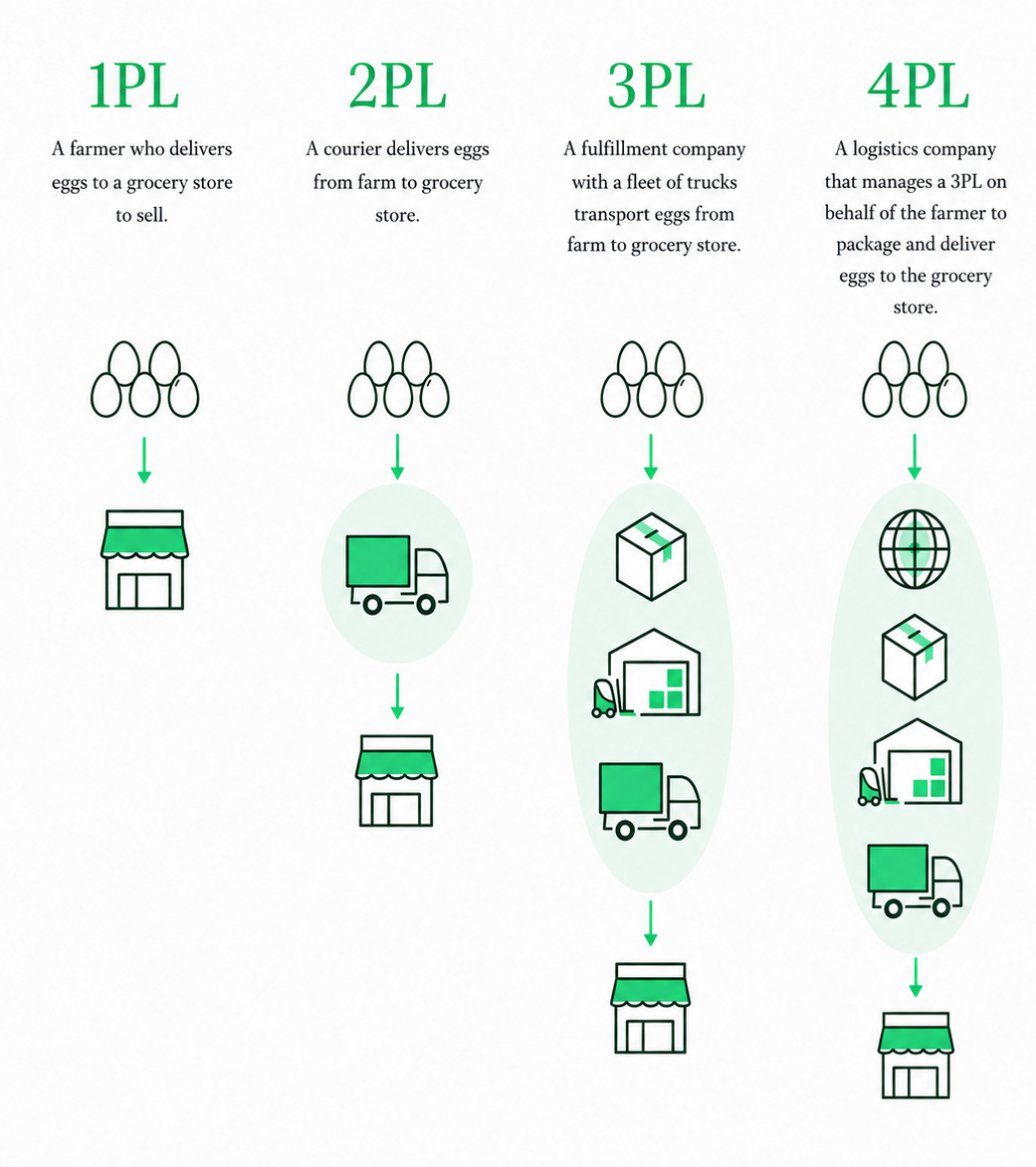
The problem of managing a fragmented supply chain is not a recent one. Starting in the late 1900s, companies began to see their supply chains and associated vendor relationships grow in both size and complexity. In 1996, an Accenture consultant named Bob Evans introduced a solution: the fourth-party logistics (4PL) provider, a model by which a company could outsource the entirety of its supply chain management to a single external partner to manage its full 3PL network on its behalf. Unlike 3PLs, 4PLs were by definition asset-light, selling the management services and analytics layer that sat on top of the 3PL network.
True to Evans’ background, early 4PLs were essentially consultants focused on increasing visibility into supply chains through centralized project management and coordination, sitting atop the underlying logistics stack and managing across it. As companies such as Accenture, Deloitte, DHL Supply Chain, and Kuehne + Nagel digitized throughout the early 2000s, their 4PL offerings became increasingly tech-forward, assuming the additional responsibility of building out and operating the systems that connected the parts of the chain. Managed transportation emerged as a sub-sector of the 4PL model specifically supporting freight, long considered one of the biggest pain points of any supply chain. As the model evolved, that scope grew to encompass the end-to-end logistics stack including carrier selection, routing, freight audit, load optimization, and last-mile delivery.
Currently, the largest managed transportation companies fall into two camps. Asset-based carriers such as J.B. Hunt layer managed transportation services on top of their owned fleets, while asset-light brokers such as C.H. Robinson, Total Quality Logistics, and RXO compete on the scale of their 3PL carrier networks and the quality of their underlying data infrastructure. This incumbent structure, however, was built for a more stable era. Today, tariff whiplash, route disruptions, and demand volatility are exposing the downsides of reliance on rigid and costly legacy brokers, posing the question: is the time ripe for a new era of managed transportation?
In previous eras of supply chain upheaval – most recently during COVID – we’ve seen 4PL-style orchestration companies across adjacent categories gain meaningful traction. Venture funding for this category hit a fever pitch in 2022 as the pandemic exposed the risks of relying on asset-heavy, capitalized infrastructure amidst a worldwide logistics breakdown. In the warehousing and fulfillment category, disruptive offerings such as Stord, ShipBob, Flowspace, and Flexe leveraged distributed 3PL partner networks and proprietary software to give brands access to flexible, scalable fulfillment solutions. Some tech-enabled freight brokers found success, such as Transplace (acquired by Uber Freight in 2021) and Flock Freight (which raised more than $450M). Yet other plays like Convoy famously failed after achieving nine-figure valuations, and smaller competitors including managed trans plays Loadsmart and Leaf Logistics attracted significant capital during the 2021-22 boom but floundered in the post-pandemic readjustment period.
This time, though the frenzy is comparable, some major tailwinds are shifting the landscape.
Today’s global supply chain shocks are more permanent than the last. The war has demonstrated that Iran can wield significant and lasting influence over the Strait of Hormuz, with very real consequences for global shipping and commodity prices. President Trump’s tariffs have also fundamentally reshaped America’s reputation on the world stage as a reliable trade partner.
Shippers want to offload risk, with increasing urgency. Firms have begun adjusting their supply chains to a “new normal,” prioritizing agility over scale and accepting that resilience will come with both higher costs and greater overall uncertainty. And as AI generates increasingly creative and effective ways to commit freight-based crime, companies are searching for more permanent ways to curb losses in this area.
Technology is no longer the gating factor. Operationally heavy businesses have always been hard to run – not just because they are logistically challenging, but because they have lagged in tech enablement and digitization. However, recent AI innovations in supply chain technology have materially lowered the cost of adoption and are projected to radically reduce the difficulty of managing disparate transportation systems. In particular, AI has the potential to enable breakthroughs in coordination, tracking, and real-time pricing visibility across rail and air, two historically complex modalities which, with the right solutions, will make global supply chains increasingly adaptable.
There is now a market for uncertainty. In April, the Intercontinental Exchange launched four new container freight futures covering shipping lanes between the U.S., Asia, and Europe. Though freight futures and derivatives have existed for decades, the absolute explosion of prediction markets onto the scene has revived the use of hedging as a strategy to mitigate risk by normalizing the concept of trading against real-world outcomes. Already, nascent offerings such as Pillar AI and Hedges allow participants to hedge against supply chain volatility or fuel price increases. We see a continued opportunity to insulate big shippers and freight forwarders from future pricing uncertainty.
The world has changed, and not just because those unused N95s are now gathering dust in the back of your bathroom drawer. With such strong tailwinds, it might be time to seriously revisit the managed transportation model. If you’re building to make transportation easier, cheaper, and smarter, we want to hear from you. Please reach out to zullo@equal.vc and chelsea@equal.vc.