


Follow the discussion on LinkedIn.
For a population that claims to hate ads, we certainly do spend an eye-watering amount of money on them. Global ad spend surpassed $1T for the first time this year, Super Bowl ad rates hit $10M for a 30-second slot, and advertising powered more than 20% of U.S. economic output and more than 70% of Google’s total revenue in 2025. As individual consumers, we are served a deluge of ads, with some researchers estimating the average person sees 6,000 - 10,000 per day. Whether you notice them or not, they are present in every feed you scroll, every podcast you play, every storefront you pass.
Advertising predates our modern society by millennia. The earliest recorded advertisement, The Papyrus of Slave Shem, is from Egypt and dated some 3,000 years old. The author of the papyrus offers a reward for a runaway slave but can’t resist plugging his business in the process, promising a gold coin for any helpful news delivered to “the shop of Hapu the Weaver, where the best cloth is woven to your desires.” As human civilization has evolved, the medium of advertising has evolved alongside it. From print to broadcast to website to mobile, we have seen each generation of advertising advance alongside the technological shifts of the time. Yet no matter the channel, advertising has always been about matching a message to a person at a specific moment. Each frontier of ad technology has simply built on (or disrupted away) the previous modality to find and optimize that match a little better.
Today’s advertising stack runs almost entirely through Google, Meta, and Amazon, which together account for more than 62% of digital ad spend globally. Each of these platforms operates as an independent walled garden with its own demand, inventory, and measurement tools. This structure was borne out of three major market shifts over the past thirty years, with clear, disruptive winners emerging at each stage.
Broadcast → programmatic (1990s to early 2000s). The internet era introduced a transition away from print, television, and broadcast media to thousands of new publishers (websites) with no standard way to serve or measure ads across them. Cookies made basic tracking possible for the first time, but the fragmentation of the publishing landscape necessitated the adoption of new technology by agencies that were used to managing dozens, rather than thousands, of end channels. DoubleClick, which was acquired by Google for $3.1B in 2007, built the ad-serving and management layer for the early web, allowing advertisers and publishers to manage ads across websites for the first time using its Dynamic Advertising, Reporting, and Targeting (DART) platform.
Manually negotiated → real-time bidding (mid-2000s to mid-2010s). As the internet continued to grow, it outpaced the existing form of “insertion order” media buying, which required advertisers and publishers to formalize ad campaigns via purchase orders that detailed dates, budget, placement, specs, and KPIs. The process of drafting and signing contracts for every campaign rapidly became too burdensome for the quantity of online ad inventory available on the market. In 2010, the Interactive Advertising Bureau standardized OpenRTB, the new protocol for real-time bidding (RTB) that set the foundation for today’s style of ad auctions. The Trade Desk, founded in 2009, foresaw not only this market shift but also the desire for agencies to bid and buy via a neutral, third-party platform rather than publisher-owned marketplaces; it went public in 2016 at a >$1B market cap and serves thousands of corporate customers today.
Desktop → mobile (2010s). As mobile phones became mainstream, so did an entirely new ad interface: the mobile app, and in particular, the free-to-play mobile game. Cookies, which had powered the ad transition to online, didn’t work in apps, so the ecosystem necessitated new distribution and monetization tools based on cost-per-install rather than the traditional cost-per-mille (CPM) economics underlying website advertising. AppLovin, which trades at a ~$140B market cap today, built one of the first mobile ad networks, mediation platforms, and user acquisition engines to help game developers find and monetize users at scale, finding product-market fit with the long tail of small to mid-size app developers who lacked the resources and scale to build proprietary sell-side capabilities.
In its current state, the advertising value chain passes from advertiser (the brand or company trying to sell a product) to publisher (where the ad ultimately appears) with many handoff points in between. Advertisers contract out to agencies to research and identify target markets, draft and approve creative, and strategize campaigns in line with budgets and performance goals. Agencies then bid, buy, and manage advertising slots via demand-side platforms (DSPs), which consolidate and automate RTB across the advertiser’s publishing channels. On the other side of the bidding process is the supply-side platform (SSP), which holds the publisher’s available advertising slots and runs auctions to bid out the slots to the advertisers. The place where the DSP and SSP meet is called the ad exchange, though this has now functionally merged with the SSP into a single marketplace. In practice, bidding, buying, and ad placement take place within milliseconds, so that when you open an app on your phone, the ads that you see for swimsuits or watches or sunglasses as you scroll have been placed there in real time based on the user cohort that you represent.
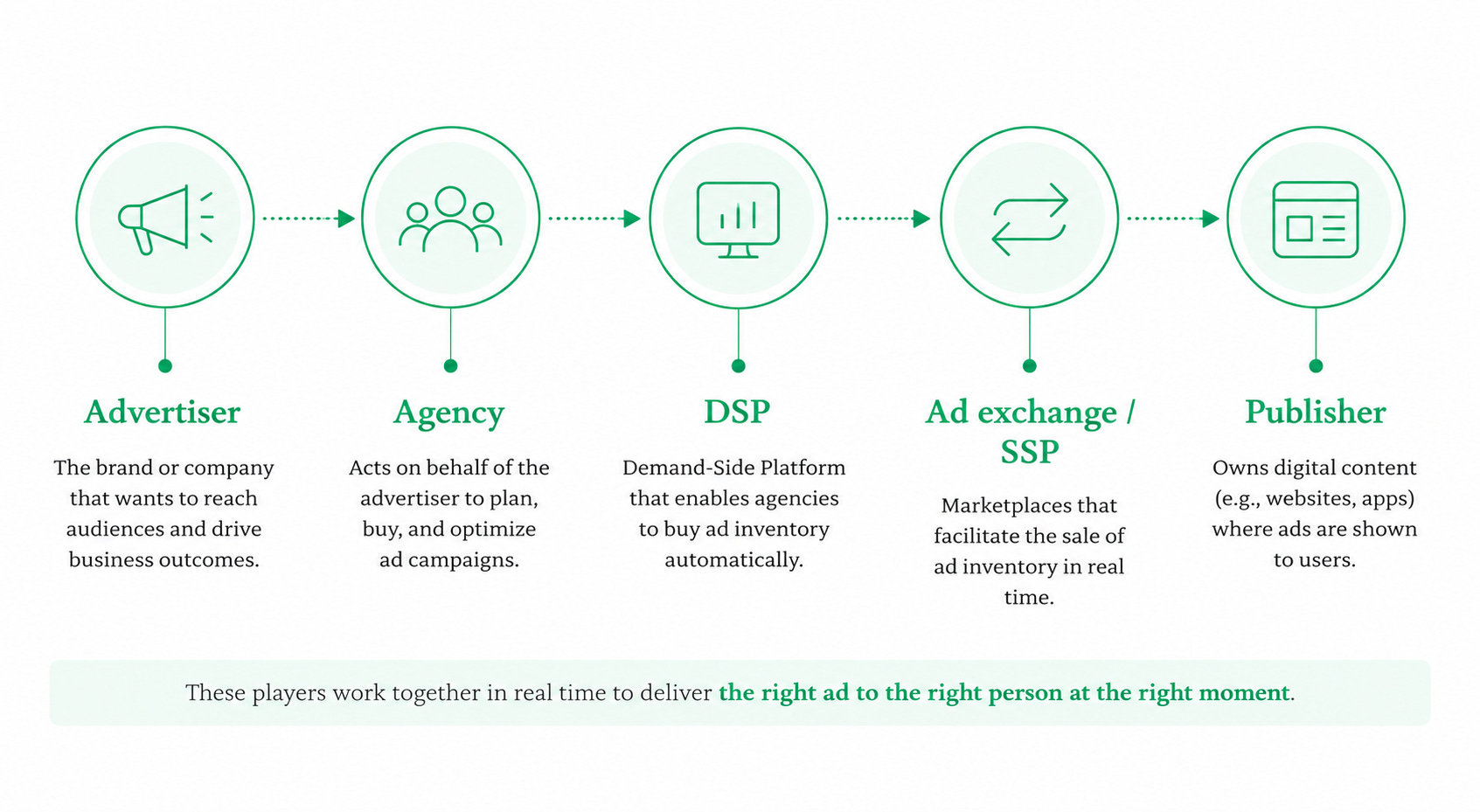
The current advertising value chain
Given what’s occurring in today’s tech world, we have to believe that the next frontier of adtech is AI-powered, with several major tailwinds propelling a potential shift from programmatic → agentic advertising.
The first is infrastructural: in October 2025, a coalition led by adtech veteran Brian O’Kelley and including companies such as PubMatic, Optable, and Scope3 released the Ad Context Protocol (AdCP), an open standard for agent-to-agent communication spanning discovery, bidding, buying, and campaign activation. AdCP is built on Anthropic’s Model Context Protocol, which was introduced in November 2024 to connect and enable interoperability for AI systems across external tools and data sources.
Just as OpenRTB standardized real-time bidding in the programmatic era, AdCP codifies the “language” that agents use to coordinate across different DSPs, SSPs, and publishers to optimize ad spend and placement. Adoption is still early and challenged by the release of proprietary servers built on the MCP by Amazon, Meta, Google, and other walled garden DSPs / SSPs that would prefer to own their integrations directly. Yet the foundation now exists for less tech-native or resourced players to enter the field; Omnicom, for example, has started experimenting with AdCP’s capabilities for agentic media buying use cases, as has Magnite, which built and released a new seller agent earlier this year. Agents are also emerging in the upstream design and creative layer, with tools like Amazon’s Creative Agent allowing advertisers to better customize and target their creative strategy toward different audiences.
In addition, the move toward LLMs and chat interfaces as the primary levers for discovery and purchase intent – with more than 50% of consumers now using AI-based search for product research and recommendations – has positioned the chat window as the platform where the next generation of advertising will be built and won. The real unknown is the effect of this move on the macro landscape. It’s very possible that OpenAI joins the triopoly of Google, Meta, and Amazon as the next consumer winner, and that these players close off further, each building higher walls around their respective gardens (excuse the metaphor). In this case, it would make sense to build deep for these existing channels, with some differentiation across mature (Google, Meta, Amazon) or fast-growing (OpenAI, Walmart Marketplace, TikTok). But you could also believe, as we do, that there is meaningful leverage in supporting the long tail of distribution, as AppLovin discovered in the desktop → mobile era by aggregating fragmented supply and demand across mobile games that were unsupported by the big players.
With this context, we see three distinct opportunity areas for the next frontier of adtech.
1. Build deep for the mature landscape with new technology
Though the technology is evolving, advertising powerhouses like Amazon, Google, and Meta will not be disrupted away so easily. Rather, new tech will serve and win share of wallet with existing platforms.
In this space, Pacvue and Skai currently dominate as the clear enterprise category leaders in channel management, with AI capabilities such as Pacvue Agent and Celeste AI automating omnichannel management on their platforms. The Trade Desk also recently announced Koa Agents to execute campaigns in real time. On the startup side, Gigi and Caples.ai go deep on single platforms (Amazon and Meta), automating end-to-end ad workflows within these ecosystems, while Laurence and Kovva’s agents bid and buy in real time against advertiser targets and campaign strategy.
The TAM here is massive – forecasted to hit $1.6T by 2030 – yet it is a proven and saturated market experiencing steady, not explosive, growth. The landscape is crowded, so success in this space is less about disruption and more about defensibility; winners will have to go deep and build real differentiation against incumbents to do well.
2. Build for the next-gen surface of conversational AI
Conversational interfaces are already a new discovery and purchasing surface for users – we discussed our perspective on it here if you want to read more. In recent months, the AEO / GEO space has continued to heat up as brands and creators search for the best tools to serve a channel rapidly disrupting how consumers search and shop online.
Already a few key standouts are starting to emerge. Profound has ballooned to a unicorn valuation just 18 months after its founding as a platform that allows enterprises to track how AI describes them and generate optimized content to actively shape those answers. Prorata helps creators verify that their content is being accurately cited and monetized across AI-generated answers. Smaller startups like Smalk AI help advertisers and publishers adapt their discovery and monetization strategies to the agentic ecosystem, while Nexad sells an AI agent that autonomously runs and monitors ads on behalf of advertisers.
This market is nascent relative to the existing landscape, with U.S. spend on AI search ads projected to hit ~$26B by 2029. While the TAM is smaller, projected growth is in the triple digits (current spend sits just over $1B, setting the CAGR around 125%). Though category leaders may be taking shape, there is still a lot of room to win here, particularly as the supply side continues to be built out.
3. Build leverage outside of the walled gardens
As discussed, the AI app landscape is rapidly fragmenting into a long tail that represents a collective and meaningful opportunity set outside of the walled garden platforms. The incentives to serve this market are strong, compounded by the reality that usage-based pricing is replacing the heavily subsidized inference costs that used to power most GenAI apps, squeezing margins and pushing them toward monetization at increasing speed.
This is the least mature of the three opportunity areas that we see. On the demand side, Dappier builds customized conversational AI experiences for advertisers seeking to become more AI native. On the supply side, Koah Labs and Imprezia provide SDKs for AI apps to monetize their platforms, explicitly targeting the long tail of consumer apps as customers, while Kontext (ad generation for consumer AI apps) and Thrad (an SDK and API for contextual ad placement across AI apps) tackle the creative and demand layers.
Similar to above, this is a small but rapidly growing opportunity area: the global AI app market was valued at $2.9B in 2025 but projected to hit $26B by 2030. No single company has yet emerged as a forerunner, though history suggests that the ultimate winner will successfully accrue durable leverage by aggregating the supply and building atop it.
–
We’re certain that adtech is entering its next phase, whether within the existing ecosystem or an entirely new one. As a non-consensus firm, we don’t like to bet on what’s already hot. Rather, as we watch the field grow busier, we’re looking for the players on the sidelines, observing the gameplay and coming up with new rules to win. If you’re building in adtech at the fringes, diving into what’s unexplored, and seeing the opportunities that others aren’t, we want to chat. Please reach out to chelsea@equal.vc!