

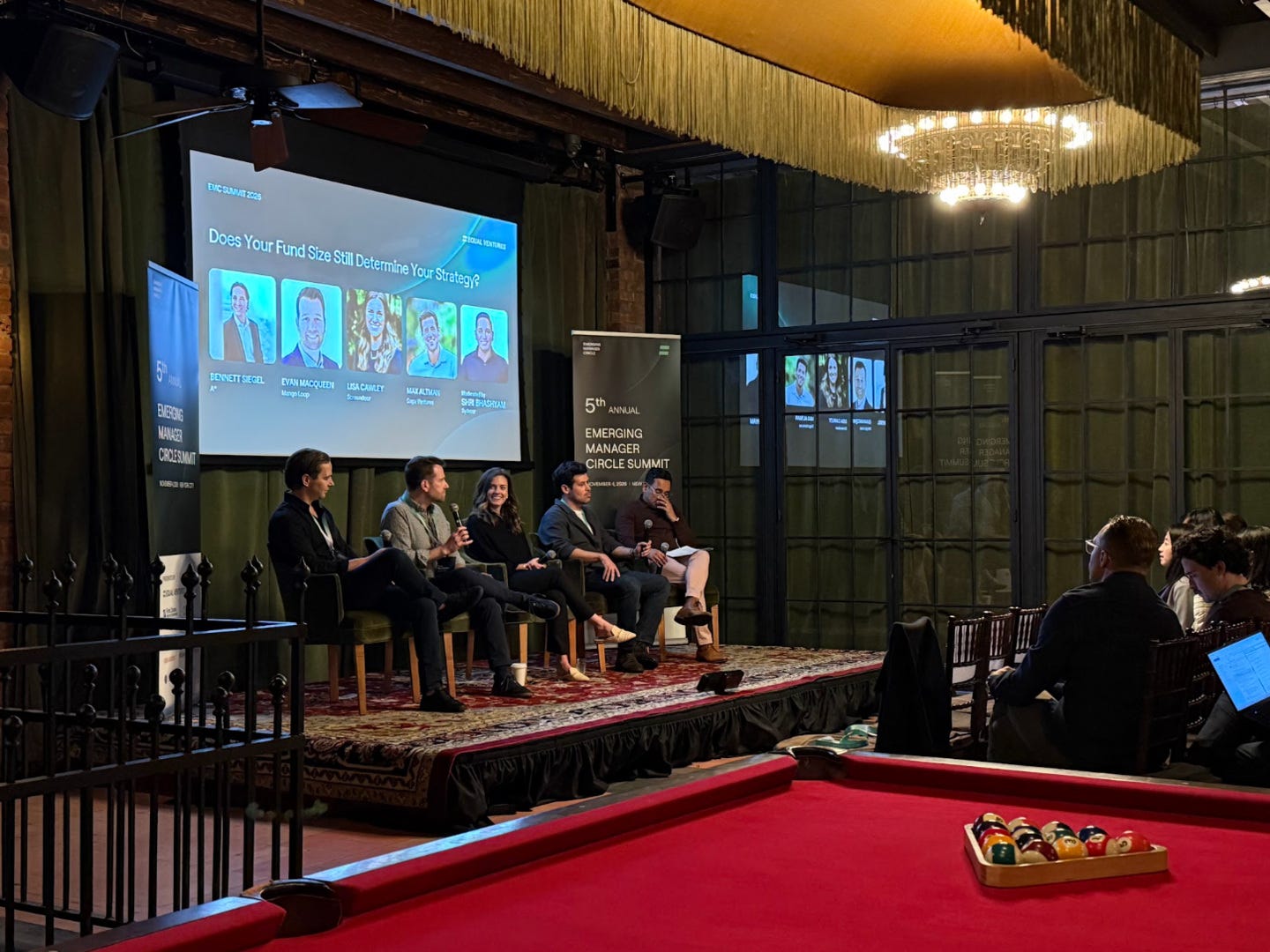
Follow the discussion on LinkedIn.
As most of you know, the content of our Emerging Manager Circle (EMC) sessions is confidential. Some of my favorite moments of these events have been when speakers share stories that they have never shared elsewhere – ones that show their vulnerability in an industry that is propped up on bravado. I’ve really admired the braveness of these folks to show the human underneath amidst our audience of fund managers and LPs and preserving the confidentiality of the individual sessions is how we honor that.
What we try to do instead is to share the learnings we have from those sessions. This year we hosted speakers who collectively have a total of 43 Midas List appearances along with LPs who deploy tens of billions into venture funds. We did this during a funny time in the venture ecosystem, where it’s really hard to tell what future lies ahead. The Nasdaq is popping back and forth like a pinball having recently shed trillions of market cap, but we’re also seeing the culmination of some of the biggest venture-backed IPOs and M&A events ever. This activity is coinciding with a redistribution of power within the venture industry itself as capital concentrates behind a small set of large platform firms and a handful of what a LP described as “boutique specialists”. The venture market looks very different from when we started our firm back in 2019, so it’s becoming more important than ever to bring a group together like this, to cut through the BS and discuss what is really happening on the ground.
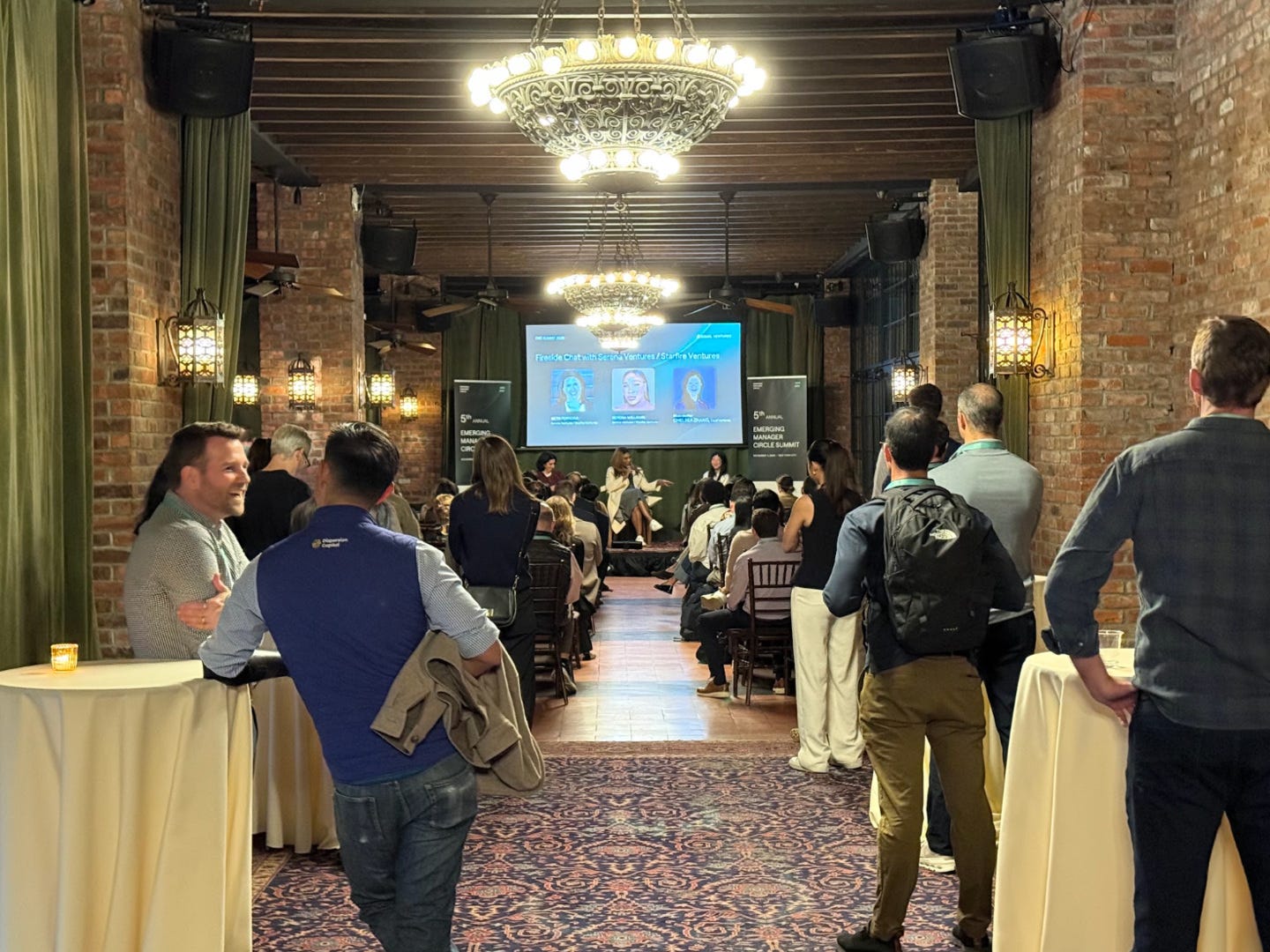
Below are my top 3 takeaways from the 5th Annual EMC Summit:
1. Venture Capital is not extinct, but the traditional playbook may be
This is a topic I’ve been writing a lot about over the last few years and it was great to see respected GPs and LPs tackle it. VC is no longer the cute, cottage industry it once was – it’s now aggregating dollars on the scale of mainstream private equity funds. Unlike in PE, however, the dispersion of returns goes to the tails, not the mean. This is accentuated by the need for downstream capital for early-stage companies and while there used to be a diverse array of downstream partners for businesses that were working, everyone largely acknowledged that platform funds were picking their bets in consensus categories early and attempting to king make them with capital. In any consensus category, this meant pricing was distorted early as was your cap table, which quickly inherited high valuations and a large preference stack, often when companies had limited revenue. While many funds used to be able to play the game of front-running the big funds, many acknowledged the movement of large platform funds into seed investing, further escalating prices and making it difficult for smaller funds to win in those markets. Several GPs and LPs felt there could be opportunity in investing in non-consensus (or as we like to call “pre-consensus”) themes, but acknowledged that raising capital for funds can be incredibly difficult without mark-ups. This dynamic leaves many sub-scale funds between a rock and a hard place, forcing GPs to find creative ways to earn their “right to win”, while making manager selection for LPs more important than ever before.
2. “If Sex and the City was shot in 2026, Mr. Big would be a VC”
Several folks acknowledged the social glorification of the VC world and how it’s changing the composition of teams and talent. Celebrity VC is now a mainstream model (demonstrating great success), TBPN is following VCs around as if they were actual celebrities and even the previously quiet, stoic firms are getting loud with their approaches to marketing, outreach and engaging with a digitally native universe of founders and LPs. At a conference I previously attended, one of the speakers proclaimed that they spend 40% of their time on marketing efforts for their firm (including socials, blog posts and attending conferences)…that’s very different from a decade or two ago when firms barely had websites and a VC dropping by for a visiting lecture at Stanford or sitting on the board for their kid’s Palo Alto private school were about as social as they needed to be. Now, VCs need to focus on being “cool” (sorry, I don’t know the modern slang for whatever gen-z founders would call “cool” as I am not), but there was some fear that this behavior may be straying us from the true point of this business. Yes, there are more venture capitalists than there were a decade ago, but there are also a lot of folks doing deals part-time, running syndicates or simply trying to “be in the mix”. VC went from a job where the job was being an engineer’s business partner to impressing 20 year old drop-outs with fancy cars, dinners and proximity to fame. This isn’t a criticism of the world, but certainly an acknowledgement that a lot of VCs are focusing MUCH more on their image with even the highest-performing firms investing heavily in marketing to court the next generation of founders that may be unfamiliar with their past success.
3. There is no right playbook, just your playbook
Everyone acknowledges that there are multiple ways to win in venture. We all squawk about our best practices on Twitter, but the reality is that folks have made money a LOT of different ways in this business. What doesn’t work, however, is trying to play this game in a manner that isn’t a fit for your skills, team and fund size. An emerging manager attempting to practice the mega fund playbook is likely to be just as successful as a guppy going against a Great White. So much of the discussion from both GPs and LPs honed in on managers identifying their unique “right to win” amidst a market where the median firm simply can’t compete. Founders and LPs have an incredible supply of managers to choose from right now, so figuring out your unique strengths and crafting a strategy around that is paramount not just to success, but to survival. If ever there were a time to push behavior, strategy and approaches to the extreme, it’s clearly now as it’s simply too easy to get lost in the shuffle of other firms unless you have found a means of differentiation that uniquely suits your capabilities.
Lastly, I’ll leave you with a final lesson and that’s one of empathy. This job often looks a lot easier than it is and a lot of managers out there are struggling to raise their funds despite lots of prior success and having produced great returns. This job is equally stressful for LPs, especially with massive positions hanging in the balance. Amidst this (or perhaps because of this), there is a lot of aggressive behavior amongst VCs and I don’t quite get it. Our job isn’t to get along with everyone, but I do think we should be able to empathize with everyone and that’s one thing that I really love about this event. Some of the funds we have are as small as $20m of committed capital. Others manage billions of dollars. That doesn’t make one better than the other; we all are starting somewhere trying to build an investment firm that reflects our belief systems - the theses we believe in, the founders that inspire us and the partners that bring the best out of us. When Fred Wilson of USV was asked “When did you first feel like you were no longer an Emerging Manager?” at our first summit in 2021, he said “I didn’t, I’m still emerging”. Fred is inarguably one of the best VCs of all-time and if he can bring that sense of humility, I think it implores all of us to do the same. Empathy is in short supply, not just in venture, but everywhere. When I started this group back in 2019, I needed all the help I could get. In 2026, I’m not afraid to take help anywhere I can get it. I do my best to give what I can, but I always wish I could give more. As I reflect upon the time I spent with fellow GPs and LPs last week, I can safely say that empathy for one another, brings out the best in each other.
With that, my final request is that you will consider making a donation to the V Foundation. As some of you may know, my wife and her mother are cancer survivors, but last year we lost my father to complications from his leukemia. 100% of donations to the V Foundation go directly to cancer research and it’s been an honor to support the organization over the years. If you are able to, please consider donating via the link here. Together, we can achieve “VICTORY OVER CANCER”.