

Amidst what is the most mind blowing seed market I’ve ever seen, I’ve been reflecting a lot on our strategy.
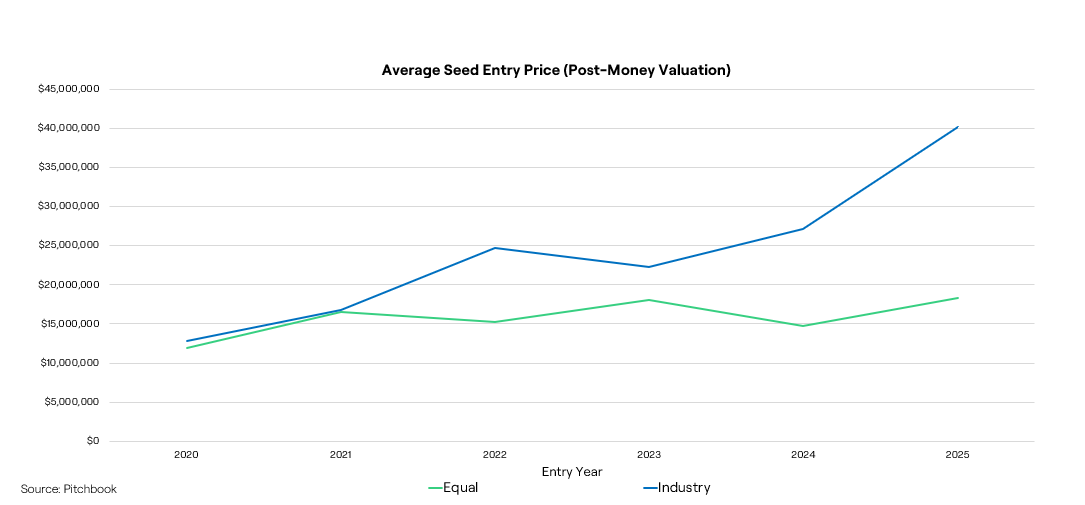
When we started Equal Ventures, we paid a slight premium to the seed market - the mean seed valuation was $12m, which itself seemed a bit absurd given that was more than double just a few years prior. That said, we were leading deals and buying into what we felt were the highest quality opportunities and as long as we got double digit ownership positions, we were relatively flexible. Over the last 6 years of Equal, however, the mean valuation of a seed stage deal has risen dramatically to >$40m. Below is a graph from our AGM this summer including the data showing how this trend has evolved.
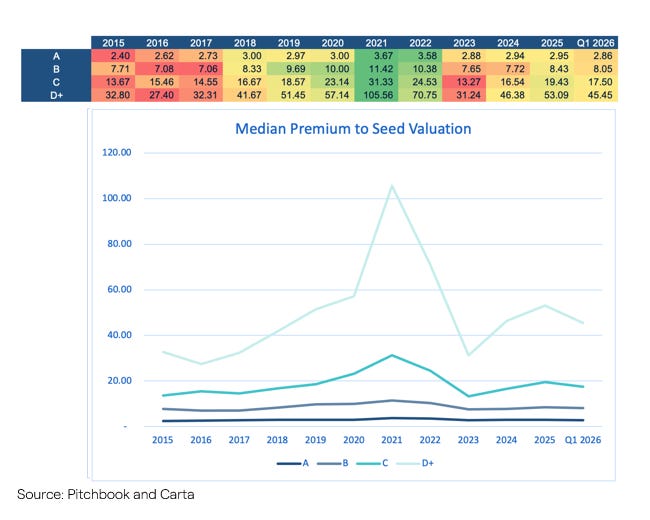
Amidst this, graduation rates have plunged and the premium from seed to other stages remains amidst the lowest it has been on record (see data below). This is despite the arrival of tranched rounds, that have meaningfully inflated headline valuations whilst the lead investors pay substantially lower prices.
I’ve discussed this dynamic with a lot of peers and there are those who maintain discipline and those who are taking as many shots on net as possible, regardless of price. Neither model is wrong, but I do think it requires thoughtful consideration.
When we started Equal, we followed the best practices of other high conviction seed investors. One of my LPs basically said “There is this guy Roger Ehrenberg, his returns are insane. If I were you, I’d follow his playbook the best you can.” And it fit. High conviction, high concentration, theme driven. We didn’t follow everything perfectly, but there was a model to follow, just as some of my peers had followed models established by SV Angel, Founder Collective, First Round (which are all very different) and others. I would have been more than happy to deliver performance on par with the average seed firm and certainly with the high conviction peer set we were trying to comp to. The mean was more than good enough for me to build a career in venture.
Since then, a lot of the underlying assumptions of the market have changed. Seed is brutally competitive and while the mean returns of early-stage venture may have previously been acceptable, the Cambrian explosion in competition and price change that. I’m proud of the returns that we have achieved (at least those on paper), but it’s impossible to ignore the delta in competitive dynamics between now and then. I don’t believe average/mean performance will be good enough in the years ahead to justify existence, only the exceptional will survive. And that requires the risk you bear with deviating from the herd.
A lot of LPs try to force GPs into a model that they’ve seen work in the past and if ever there was a time to break from that, it’s now as the rules of venture change. As I speak with fellow fund managers recognizing the need for their strategies to evolve given the centurions of the market, I’m reminded by some of my conversations with Brian Singerman (another one of our EMC firesides) who would tell me to “play the game that you are best positioned to win, not just compete’.
Inarguably, I’m well below the average venture person on virtually every measurable accolade or trait, but I think self-awareness of your strengths and weaknesses is the first step to ultimately turning them into sources of differentiation - where you can demonstrate divergence from the mean and play the game that best suits you.
I don’t pretend to have all the answers, but I know I don’t want to be “mean”. I suspect a lot of VCs are happy to play the asset accumulation game as they round out the clock on average performance as the strategy requires little risk and is a really great business model. If you catch a $100b outcome, you can produce great returns and if you don’t, you collect a lot of fees in the meantime. Unfortunately, it’s not in my nature to invest that way. We are high concentration, independent conviction investors. That is our model and everything we do is in service of that. We may lose, we may win, but we will NOT be the mean
As Wayne Dyer said “If you follow the herd, you’ll end up stepping in shit.“ There is enough shit out there in the market, I don’t think we need to step in anyone else’s.
Rick, your analysis resonates deeply with what I’ve been sensing about venture capital. The rules of the game are changing, and Brian Singerman’s advice captures something fundamental: the goal isn’t simply to compete, but to find the game you’re best positioned to win.
It reminds me of Blue Ocean Strategy — creating an edge not by fighting harder in crowded markets, but by finding opportunities where your unique strengths can become a real competitive advantage.