


Follow the discussion on X.
Yesterday, there was a great post by Chris McCaan of Race Capital (I don’t personally know Chris, but enjoyed the post), discussing the binary nature of Series A financings in this market. As Chris said, “Capital hasn’t disappeared, but its concentrating around a smaller set of perceived breakouts. Series A used to behave more like a curve, where strong companies could find a price, now it is becoming binary.”
This dovetails with a conversation that I had with a peer of mine who has been in venture for 17 years at top-tier firms who noted “VC has become a caricature of itself…there is an incredibly small landscape of what the big funds want to fund right now (explosive AI growth stories, defense tech, data center buildouts, frontier tech) that it’s virtually impossible to get even great businesses funded outside of those categories.”
We wrote about the potential for this dynamic in “The Extinction of Venture Capital” roughly two years ago and it’s largely played out as we thought it might with the tail wagging the dog. With that, I mean that we’ve seen downstream interest dictate upstream behavior in terms of what other investment firms are interested in funding and what founders are building. This is the opposite of what we’ve traditionally seen historically, where downstream investors responded to the revealed success of what was working in market. Given that much of what we are seeing funded today at multi-billion dollar valuations is either pre-revenue (in the cases of frontier and defense tech – NOTE: a LOI is NOT revenue), deeply gross margin negative (many of the AI companies) or most closely resembles infrastructure capital (data center development projects with immediate interest, but a LOT of long-term liabilities), this isn’t the same game of observing and responding to the revealed interest of customers like it used to be. It’s capital picking categories and picking winners.
I have no problem with that game. It can be highly lucrative and I understand the incentive to do so. There are about 5k VC firms that can write a $500k check and about 5 that can write a $500m check. Not only can you get more money to work in that strategy, but you have less competition amongst investors and less competition between companies. As an aficionado of competitive strategy, I respect it.
But what does this mean for founders and VCs attacking opportunities outside of today’s zeitgeist. Well, it depends.
I personally see the “non-hyped” early-stage round to be one of the best long-term opportunities in the market today. This stage of investing (A/B) has historically been one of the most lucrative stages of investing and now the market’s binary nature has left a lot of GREAT companies seeking an increasingly thin slate of capital providers. A second order benefit of that, is that there will be inherently fewer competing companies in those categories - that these companies can become more profitable and capital efficient than ever before. A decade ago, dozens of companies in a single category could be funded throughout the entire life-cycle, providing tremendous optionality to customers and driving down the long-term profit pools for the segment. Today, if you can break through to profitability early, leverage AI to stay efficient, grab the pole position in a category that no one else is funding…well, you might just have the chance to create the next Veeva (for those who don’t know, Veeva raised only $9m (a portion of which was secondary) and achieved a valuation of >$50b in the public markets). For a firm like ours, THAT is the holy grail.
I’ve thought a lot about this dynamic over the last few years and we ultimately started bifurcating our portfolio into those that we felt were ready to get on the venture super highway (those that aligned with the zeitgeist with easy access to capital) and those that seemed like they could be great business, but unlikely to receive immense interest from downstream funders and needed to operate accordingly. We called these two profiles “heaters” and “cash cows”. I shared the graph below in a LP update that I did last year titled “A tale of two markets”.
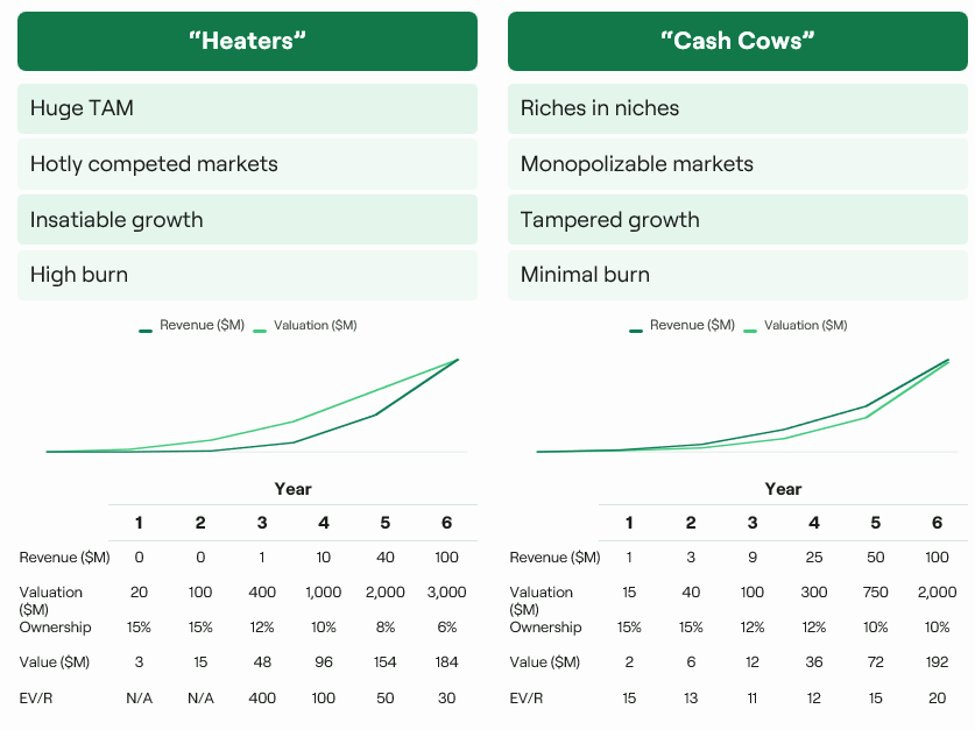
If you follow the tables below the chart, you can see that the return profile of these investments is actually incredibly similar. What is different are the interim valuations in between. Those interim valuations show as validation points to LPs, but they are also dilution points – times where you need to invest additional capital (potentially at inflated prices that pull up your dollar cost average) just to maintain ownership. We like BOTH of these profiles in our fund and think it is healthy risk management to have a bit from each as we build out a portfolio. What has grown increasingly clear to us, however, is making sure we and the founders are aligned on which of these paths they are pursuing. Being self-aware enough to know what you are and what you aren’t is one of the most quintessential lessons in venture (and life) and nothing is more destructive than operating like a “heater” (high burn) when down-stream capital won’t be there regardless of growth.
I’ve thought a bit more about the mental model we should use to assess these opportunities (both upon entry and as the companies grow) and I ultimately see it as a function of capital intensity and competition. If you look at matrix of conditions below, these two factors determine the type of business you need to run and which skills are most important.
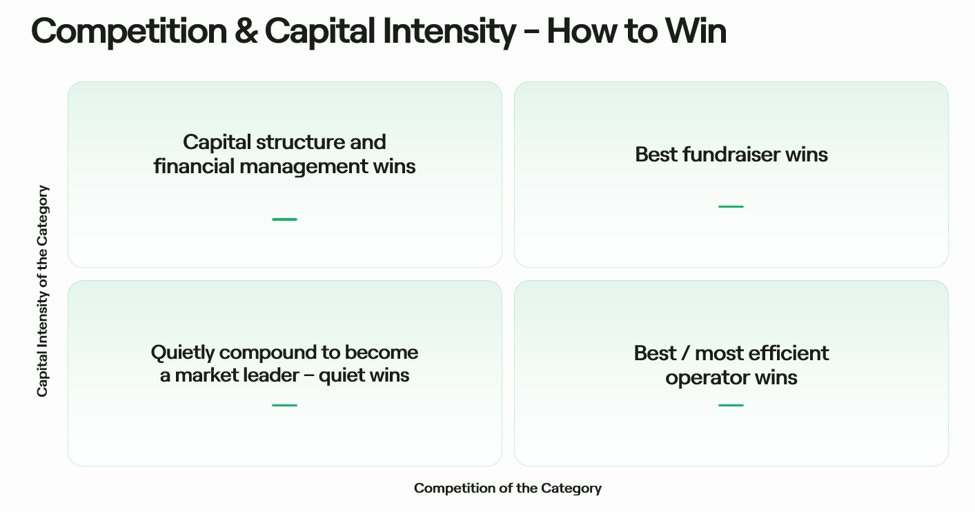
High competition and capital intensity (much of what is today’s current zeitgeist environment) incentivizes those who are the best fundraisers given the need/opportunity for downstream capital to provide a lasting advantage to the business. There are also capital intensive structures that have limited competition (partially due to their capital intensity) and while fundraising is deeply important in this category, capital structure is often more impactful (Hemant highlighted this earlier this week with his article on “capital as a moat”, expressing his belief that GC’s array of capital solutions were well suited to help founders win). Then there are the less capital intensive opportunities – those with competition and those without. The competitive categories are ones with low barriers to entry and will be hard fought battles. Ironically, given the amount of competition, some of these may elevate to become much more capital intensive businesses as we are seeing playing out in what were formerly quiet, capital efficient spaces like the insurance TPA market. That said, our favorite of all 4 quadrants on this chart (or what we would call the “Veeva Quadrant”) is the bottom-left, the quiet compounders.
As I think of the companies in our portfolio, some of the most exciting companies we have are in the bottom-left quadrant. They spend very little on sales and marketing, the CEOs are focused on their customers, their products and their teams > their social media profile or fundraising efforts, and they are owning new emergent categories with stellar efficiency. AI is a massive accelerant for these companies, enabling them to operate more efficiently than ever before, which is why many of the companies that we have in this category never raise despite tremendous performance.
Mike Maples once said “Patience is a form of arbitrage”. Never has that been more true than today. We’ve had several companies go from $2-5m ARR to $20-$50m ARR without a single mark-up because they don’t need the capital. As former PrinCo leader Andy Golden once told me, “Fundraising is an extremely expensive form of price discovery.” We’ve had these companies growing >100% per year that are cash flow positive and we currently have them on our books at 2-5x revenue. These companies don’t pump our interim returns the way that the heaters do, but frankly, we don’t need them to. We have enough “heaters” to post strong returns and we have a LP base that understands fundamental value and the beauty of quiet compounders. They understand the “Power of Patience”.
Not every firm can do that in a market like this (which is one of the most brutal fundraising environments for emerging managers that I’ve seen) and we are incredibly fortunate to have a LP base and a portfolio that can align on this type of strategy. While heaters and interim marks will grab the headlines, I’ve seen how some of these paper marks can come crashing down with a preference stack on top of you and I worry about the impact that can have on venture portfolios in the years to come. For Equal, we’ll continue to invest into both of these strategies, preaching self-awareness, efficiency and a relentless focus on creating real businesses (not just mark-ups), but I can’t help but feel that there is a dramatically underserved opportunity for the bottom left-quadrant. Investing in this quadrant seems likely to yield some amazing long-term results for the firms that can afford to be patient enough to see those outcomes play out. Admittedly there is a heavy dopamine response to one of our companies raising at a big valuation, but as philosopher Jean-Jacques Rousseau said, “Patience is bitter, but its fruit is sweet.”
Extremely well said. I love the quiet compounding approach. It's more sustainable for the founders and lower risk for everyone.