


Like at the other last few major commerce conferences (e.g., NRF, Fashionology, our own Commerce Capital Summit), “AGENTIC COMMERCE” was inescapable at Shoptalk Nashville. The recent launches of Claude Commerce Agent, Instinct, and Muse, and the subsequent hullabaloo, made it a particularly exciting summit - as Gwyneth croons in my favorite country song from a movie, “Timing Is Everything.” In between walking the floor and moderating a panel on operational agility with some awesome operators, I tried to get a pulse on what’s actually happening on the ground with real brands and how they’re navigating this fast-shifting and murky market. So let’s dive in!
1. Recent buzz around personal AI agents has kicked off another wave of agentic commerce excitement (and fear).
A new class of horizontal personal agents has blown up over the last few weeks. Notable ones include Instinct, Town, OpenAI’s recently announced Dots, and Meta’s Muse, which enjoys the small advantage of Meta’s existing 3.6B in DAP, or 45% of the world’s population. Early adopters are breathlessly recounting success (and horror) stories as Instinct and Muse agents run around to execute on early use cases like travel, calendars, emails, and maybe, finally shopping? Instinct reportedly already does around $1B in transaction volume (half from travel) and was valued at $10B within weeks of launch. Town’s CEO has predicted that within a year people will spend 40% of their digital work time inside an assistant instead of going to apps and websites directly.
The reactions from major commerce platforms unsurprisingly reveal their incentives. Shopify, which has long embraced agentic commerce because it owns the checkout, announced its partnership with Instinct and Muse immediately. Amazon, which relies on ads revenue (20% of LTM GP and its highest-margin revenue stream), blocked Muse explicitly and has a general block against unauthorized automated bots, which Instinct falls under. Ultimately, no advertiser is paying the big bucks to advertise to an agent (yet), which is also why I believe that Muse will be a much bigger lift for Meta’s advertising business in the short-to-medium term than its shopping ambitions (CC IG Shop).
These recent developments brought in a fresh wave of questions from brands and retailers, many of whom are still reeling from the AEO / GEO craze. Many scaled retailers still don’t have the ability to accurately track whether a visit came from a human, an agent, or a human who’s landed on the site after a discussion with an AI chat. Unsurprisingly, the initial unleashing of millions of Muse and Instinct agents into the wild has been met with mixed results. Companies like Delta, United, eBay, Yelp, Zillow, Pizza Hut, and Adidas are reportedly intentionally blocking agents, primarily citing security as the main concern. No one wants to give up the direct-to-consumer relationship, and frankly, many may not be set up to handle the sudden inflow of agentic traffic. There are also reports of supposedly live integrations (e.g., Walmart) that aren’t working as expected, and even with completed transactions, consumers have reported that agents ordered the wrong size or color, paid more, or exceeded a “reasonable” price cap. The early reviews are a helpful reminder that the barriers to “agentic commerce” are not merely the reasoning capabilities and context sophistication of the agent. Buy-in and change management from retailers, marketplaces, and even major financial institutions will be required before “agentic commerce” fully arrives.
2. Is the future of the storefront “tail-less”?
However, I do believe that the agentic commerce moment is inevitable (I will plead the fifth on the actual timing). I would be hard-pressed to bet against a future when consumer agents become productive (or entertaining) enough that they start holding a significant amount of consumer attention. Ultimately, whoever owns the consumer holds all the cards, and the major retailers and platforms will HAVE to play ball, because if they don’t, the agents will optimize and go elsewhere. Eventually, agents will be able to seamlessly execute end-to-end purchases across all major segments of the economy. Today, brands and merchants rely heavily on Meta and Google, both of which are hurtling towards the agentic age where the marketing funnel is collapsing and advertising surfaces are shrinking. It’s an incredibly sobering thought for brands that potentially, very soon, a brand’s own digital storefront may be the only place where a brand has full autonomy to dictate how it shows up to the end consumer.
However, there may be a silver lining, perhaps even two! One, a digital storefront no longer needs to dedicate any real estate to mundane details like the mechanics of the checkout, payments, and addresses. Currently, storefronts are optimized for the human experience, particularly making the click-to-cart to check-out flow as seamless as possible. What takes its place when these are all abstracted away by the agent? Two, given that consumers will need to give agents enough context to guide their shopping journey, brands may be able to access that context themselves so that by the time a consumer does land on the website, the brand has much more information on that specific consumer, that specific journey, than it does today. Ultimately, what creates value is a completed transaction, and in this shared agent economy, everyone should be working together to produce the greatest economic outcome.
We can imagine that in a perhaps-not-too-distant future, the digital storefront looks totally different. Gone will be the endless scroll, gone will be the size options, gone will be the FAQ section - 100% of the digital real estate will be dedicated to an immersive, personalized, AI-generated, on-demand experience. I had a great time speculating about the future at the Fermat Commerce brand breakfast, and Rishabh Jain, Fermat’s CEO, called this “tail-less commerce.” I love it and I’m hoping it catches on!
3. Brands are all over the place on adopting AI in their workflows, and actual AI readiness remains low.
Let’s turn our attention to how brands are actually implementing AI. On stage and off, one of the most refreshing admissions was that nobody has a secret sauce. Even the largest brands and retailers are still experimenting, and AI maturity varies enormously across the companies. A handful are running real pilots across merchandising, creative, customer service, and planning. Many are still at the “we have a working group” stage but are limited in their ability to use anything but Copilot. Anything new, especially anything touching AI, often means a long battle with IT and security over data access, vendor review, and procurement. A surprising number haven’t moved past individual employees experimenting on their own.
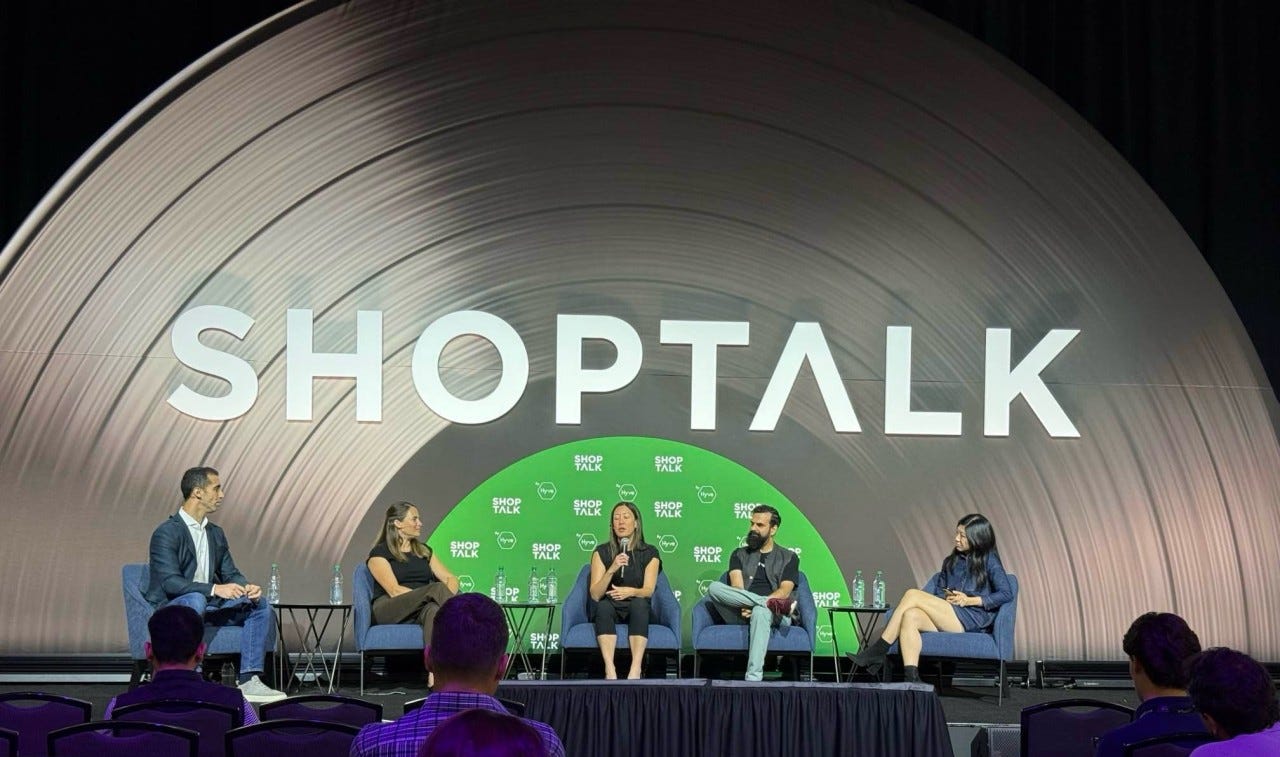
The good news is that some of this is already working! I moderated the “Tech Spotlight: Solutions Enabling Operational Agility” panel and heard from a few awesome operators - Sankalp Arora, Co-Founder & CEO of Gather AI; Kelly Breakstone Roth, Co-Founder & CEO of Prysmic; Jason Brenner, SVP, Digital Portfolio at FedEx; and Melissa Wong, Co-Founder & CEO of Zipline. Each of these operators is working to implement AI for both their customers and themselves. I was particularly struck by what Sankalp and Kelly left us with as a parting message for brands and retailers - don’t approach AI from a place of fear, and there’s no better time to start than today!
Slowly, and then all at once
There’s a real gap within commerce right now - the movement on the consumer side is outpacing the movement on the industry side, regardless of whether it’s due to fear of change or execution ability. This gap will only increase, and there’s a real opportunity for enterprising brands and merchants, and the enablement solutions, to shake up the status quo. We’re in for an exciting next 12 months!
As always, the Shoptalk team put on a great show and I’m confident no other conference could beat the live music at the Jam Session Lounge! Any founders, operators, industry watchers, or other investors interested in chatting about any of the above, feel free to reach out to chelsea@equal.vc.